Sunday, November 16, 2014

Why Superman is Still Relevant

     Sorry, late post again.  This one isn't even a review either, just some thoughts on the hero that we named our blog after, because we can never have enough of those.

     Superman is one of the few heroes that seems to have become less desirable in the Modern Era of Comic Books.  While the medium was becoming darker and edgier with the works of Frank Miller and Alan Moore, the Man of Steel was quite overlooked.  In fact, in his short commentary The Mark of Batman Alan Moore talks about how old-school heroes have not adapted to the modern world and how the social implications of their stories are missing or incorrect altogether.  He ties this in to Frank Millers’ The Dark Knight Returns and what it did for Batman in terms of making the character more believable.  Upon reading this, and revisiting The Dark Knight Returns shortly after, it wasn't sitting very well with me.  I mean, Supes is still cool right?  I’m a Batman fan to the core, but The Big Blue Boy Scout will always have a place on my shelf.  So why isn't Superman still relevant?

     One of the main arguments against Superman is that he’s a poorly conceived character.  I mean, he has dozens of god-like powers and only two weaknesses: magic and a special rock.  Of course, he is the first superhero, but that shouldn't be an excuse for bad character design.  The Model T was the first car, but you don’t see those on the streets today because we moved on to better versions.  So should we get rid of Superman altogether? 

     The problem with this argument is that when Superman was first created he kind of defined what a superhero was.  He was a modern being with powers and a secret identity and a cape on his costume.  We had never seen one of those.  The closest thing to that would have to be some god or demigod from ancient mythology like Hercules or Perseus.  Superman was a modern myth.  We don’t go around discrediting the stories of mythical gods and heroes just because they are socially unaware and ill conceived.  After a while they become so rooted in our culture that they are impossible to forget.  Sure, we have moved on to other heroes, but we constantly revisit the old ones.  Granted, if a hero like Superman were to be created today, people would be more than a little disappointed, but that doesn't mean we should throw him out.  He’s old school, and that’s refreshing and, more often than not, entertaining.  He stands for truth, justice and the American way, instead of answering to some internal system of right and wrong or existential justification that black and white come in infinite shades of gray.  He grew up with old-fashioned ideals, but that doesn’t mean he’s a social incompetent.
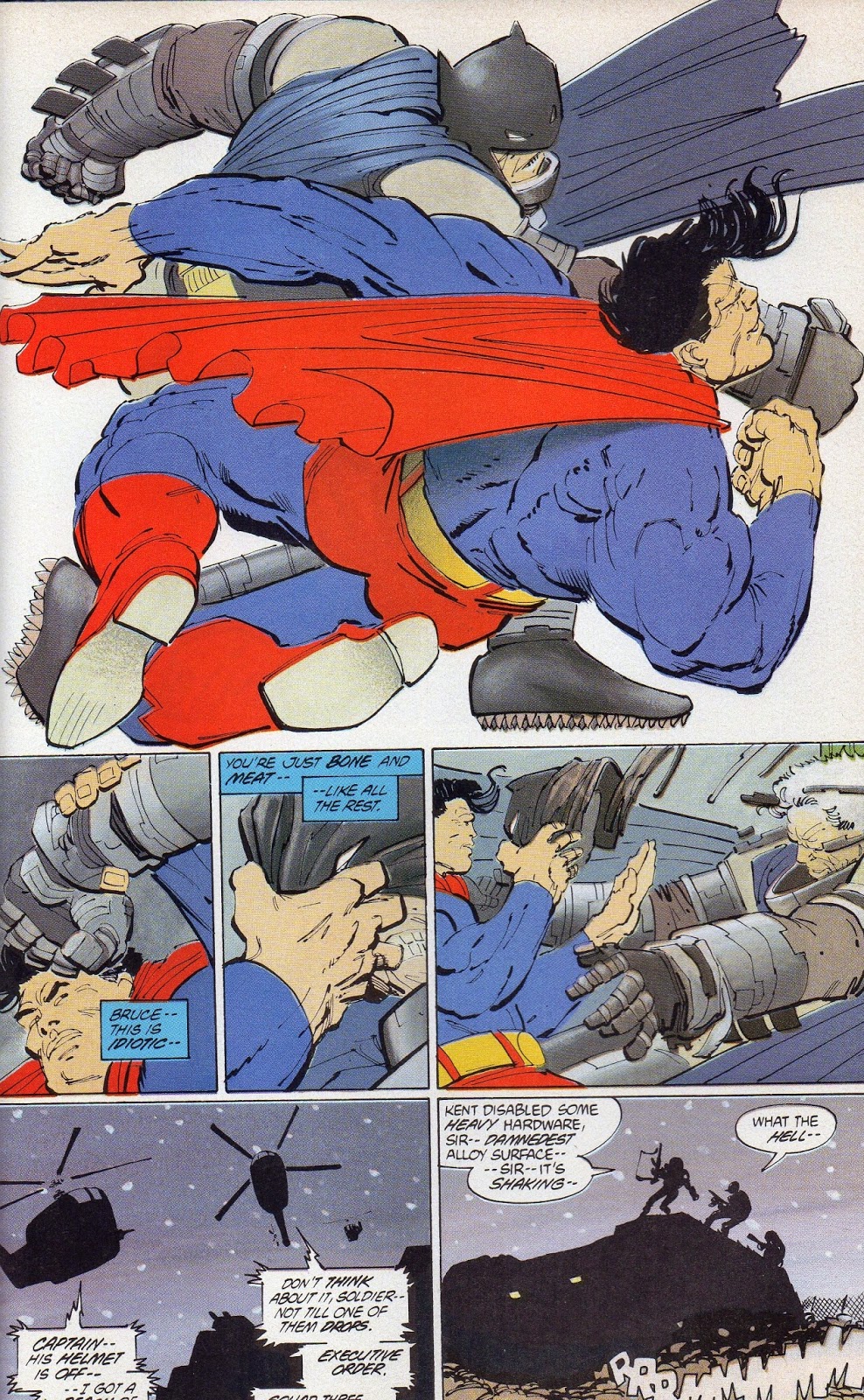

     I can’t possibly finish writing this without touching on the subject of the upcoming movie Batman v. Superman: Dawn of Justice.  Though poorly titled, its announcement has sparked many a debate between my geekier friends and I: Who’s going to win?  A lot of the die-hard Batman fans (myself included) cite The Dark Knight Returns trying to escape the fact the Superman is obviously too much of a powerhouse to be beaten by a mortal.  For those of you who haven’t read it, TDKR features a battle between the World’s Finest near the end of Batman’s career.  In the wake of nuclear war, Bruce Wayne builds himself robotic armor and challenges Clark Kent to a final battle.  What follows is one of the most iconic showdowns in comic history.

But, upon further examination, can we really call it a win for team Bats?  Not only was Superman at his weakest because of the radiation that darkened the Gotham skies, but Green Arrow and Robin both had to step in to slow down The Man of Steel.  Beyond that, after beating Superman to the ground, Batman then goes into cardiac arrest and dies for the millionth time (he of course comes back later).  The Dark Knight Returns is not canon, as is true with a lot of DC titles, so even if you count losing a fight to the death as proof that The Caped Crusader could beat The Man of Steel, you still can’t pin it on a timeline.  I’d actually like to look at a more recent example: Justice League #2.  As part of DC’s most recent re-launch they had to reassemble the Justice League in the first few issues of their title series.  In this issue Batman and Green Lantern Hal Jordan are found outside of a Lexcorp factory trying not to die as they are attacked by an angry Superman.  During the bleakest moments of this battle, Hal Jordan calls up his friend Barry Allen in hopes that The Flash can help them survive a little longer.  Halfway through the issue, the battle finally stops with Batman, Green Lantern and The Flash having to all team up to even calm Superman down enough to reason with him.  And if we’re looking at the most recent film franchise Superman is the obvious win, because he doesn't seem to care so much about whom he hurts in order to save the day (as we saw with General Zod).


     Which leads me to my final point.  In many ways, Batman and Superman are polar opposites.  Bruce Wayne is just a young boy when his parents are gunned down in crime alley, but he instantly gains a burning desire for the power he needs to enact his revenge.  He feels that he has been wronged by the criminal underworld and that he needs to be able to stop such atrocities is the future.  He then becomes The Dark Knight, a purely self-made hero that is dedicated to hunting down wrongdoers and enacting his own personal justice.  Kal-El, on the other hand, is an alien that was granted phenomenal power at birth but had some trouble finding his place in the universe after his species was eradicated.  He had the ability in the beginning, but he had no plans of what to do with it.  He could have easily enslaved the human race instead of striving to protect it.  In fact, that probably would have been easier than constantly having to stand for truth, justice and the American way.  The fact that he chose to be a hero, and chooses to be a hero every day shows much more strength than a locomotive.  Batman had the will very early on, but he lacked the power, and in that regard he is truly the epitome of self-reliance (at least in the comic book world).  Superman, on the other hand, had power thrust upon him, but could have done a myriad of things with it, and in that regard he is the epitome of self-restraint.


So as we've seen Batman transform from the campy Adam West adaptation to the darker and more realistic Christopher Nolan movies, we've wondered why Superman hasn't tagged along for the ride.  While I think an edgier Batman is a good thing, I also think that Superman is fine right where he is.  We all saw what happened when Zach Snyder tried to turn him into an anti-hero in The Man of Steel.  Superman is old school, and he should stay that way.  Batman and Superman are two ends of a spectrum: the ends justifying the means and the means justifying the ends.  But one cannot exist without the other.  In a world where anti-heroes seem to be running the show and Aquaman gets overlooked more often than not, we need to acknowledge characters like Superman more often.  And yeah, sorry Ben Affleck, Batman is totally going down.

Sunday, October 26, 2014

Arkham Horror

Arkham Horror.


If you don't play a boardgame once a week, if you don't have a group of geeky friends like you that you call up for yet another gaming session, if you don't enjoy sitting around a table playing the same boardgame for hours on end, if you're not a TRUE GAMER, then stop. Read another article. Close the tab. E-mail your grandmother. Just don't read this, because it will be an absolute waste of your time.

On the other hand, if all of the above is false for you, go ahead. Keep reading. And bask in the Horror.  The Horror of Arkham.

Published by Fantasy Flight Games in the year 2005, Arkham Horror is based off of H. P. Lovecraft's infamous short story "Call of Cthulu," a pulp horror concerning an apocalyptic organism slumbering in the darkest depths of the ocean, soon to emerge and wreak havoc on the world.

The game itself follows a similar plot: the supreme beings known as the Ancient Ones are awakening.

Yes, that means the players are all on the same team. Yes, it's one of those games.

In the fictional city of Arkham, Massachusetts, during the 1920's, players take on the role of investigators, certain individuals who are noticing the horrific changes taking place on the city. Luckily, there's around twenty of them, so you don't have to worry about being last to pick and receiving the one you didn't want.  So far I've used a different Investigator each of the times I've played, and I've enjoyed all of them.

Each investigator has their own qualities.  The two most important stats are 1. Health and 2. Sanity.   If either of them goes to zero, you are sent to a hospital or asylum and get a nice vacation from the dangers at hand.  Also, for each character, their health points and sanity points add to 10 (such as 7 health and 3 sanity, or 5 health and 5 sanity), so there is a sense of balance between the characters.


There are also three pairs of statistics: ____ ____ and ____, and for this is where the characteristics get a little unique. Essentially, these stats will change throughout the course of the game.  That is, if you want them to.

Let's take Lore and Luck, for example. My investigator has 4 pairs of numbers along a horizontal line.  One of the numbers for each of the pairs represents my Investigator's Lore, and increases from left to right. The other number in each pair represents my character's Luck, which decreases from left to right. My Investigator can only have one pair of the number's active at any given time, which is shown by a small slider circling both numbers.

In essence, each turn you can change your character's stats for that pair by moving the little slider. The closer you slide it to the left, the more the Investigator's Luck increases. The more it is moved to the right, the higher my character's Luck gets. Customization! Hooray!

However, you can only slide the marker so much.  Each character has a focus value, ranging from 1 to 3. You can only move one slider a single space for each focus point. Thus, I could move all three of my sliders to the right, or I could move just one of my sliders three times to the right.

But I'm getting way too far into this.  Let's move on, shall we?

In this dangerous town of Arkham, you are running around to certain locations on the board trying to acquire helpers, weapons, and spells to help you close the portals that are opening across the city. You pretty much have to go through as many portals as you can and close them, which slows down the awakening process of the Ancient One.


*Side note: There are 8 different Ancient Ones, each with their unique characteristics, resulting in a different game every time!

In order to close a portal, you have to go to the location it's at, go to the space the portal leads to (there are spaces on the board representing the 8 or so Other Worlds the portals lead to), and stay in the Other World for a turn. After exploring it by drawing 2 event cards and participating in the requirements, you return to Arkham and close the portal. Then, if you actually want to win, you have to try to seal the portal by making a skill roll. If you rolled the right stuff, you have sealed it and a portal can't appear on that space again for the duration of the game.

There are two ways to win Arkham Horror: seal a certain number of portals, or defeat the Ancient One after it has awakened. It is much easier to seal the required amount of portals, as the Ancient Ones are pretty tough to kill. But it is possible! I've done it before, singlehandedly.  Is there an award for that? Because there should be.

So this sounds pretty easy, doesn't it? Well, I haven't even covered the worst part: the monsters.


For every portal that opens up across Arkham, a monster appears. And monsters move. Toward you. Actually, only some do.  There's a pretty complex system to moving monsters, but I'm not going to take the time to explain it. Let's just say some of the monsters are pretty deadly. But if you kill one, you get a trophy! And trophies earn you awards! And awards help you seal gates!

But there's a monster limit to the city. It sounds pretty helpful, right? No. It's not. You see, if the monster limit is exceeded, the terror level of the city advances, and the Ancient One is that much closer to awakening. The terror level is directly related to the Ancient One.


Just a hint: when playing competitively, there is a way to add up how important to the team each player was. And believe me, monster trophies rack up a lot of points. So kill them. The monsters.

I'd say the only problem about the game (besides the monsters) is the time requirement. A single session of the game has taken four hours before. Luckily, you can choose the Ancient One (if you want to be picky), and if you want a shorter game you could pick a weaker Ancient One. This also works the other way: a powerful Ancient One makes for a longer game.

In conclusion, Arkham Horror is pretty much the game to play when you're feeling like an adventure. With it's unique mythos, complex system of gameplay, and just the general horrific atmosphere it creates, this game is one to look out for.  All in all, this game deserves a solid:


8/10

-

Sunday, October 12, 2014

Superman Earth One Review


Here on planet Earth, we are quite familiar with the Man of Steel.  He has been around a long time and is easily the most recognizable superhero across the globe.  We know his origin, how he dresses, his secret identity; we even figured out how Superman shaves. 
Your move, Gillette.

  Without a doubt, Superman is the first and most recognizable superhero this world has ever seen.  Welcome to this month's graphic novel review by the skeptic formerly known as Kid Batman.  Today we will be looking at DC’s re-imagining of their most iconic character in Superman Earth One.  This book was well received and became and instant hit and best seller.  Written by J. Michael Straczynski and illustrated by Shane Davis, this story takes us to a world that has yet to meet the Man of Tomorrow.

The Pros

    
     One of the biggest stumbling blocks for a book like this is the difficulty of renewal of iconic characters.  Superman is a character we all know and love, but if you change too much about him your story won’t seem believable.  For instance, if this new Superman had the power to eject adamantium claws from his hands and his weakness was fire, you would scoff and put your book down.  But if he wasn't different in some significant way it would be just like every other superman story we've been telling for one hundred years. Previous authors have tried this, and some have succeeded but plenty have failed, even outside of Superman titles.   

The story unfolds with a 20-something Clark Kent moving from his home in Smallville to a small apartment in Metropolis, and is trying to make a decision about who he really wants to be.  He goes to various employers and tries out a myriad of professions, all of which he is phenomenal at.  But there’s something still lingering in the back of his mind.  Earlier his parents had suggested using his powers to help people whenever trouble arose.  This is where the story begins.  Straczynski does an excellent job timing flashbacks throughout the story, giving us a good idea of what life was like for Clark before he came to Metropolis.  The writing gives us a look into Superman’s past and shows the character in depth like we’ve never seen him before.

The art is also worth noting.  This is the first time I have been exposed to Shane Davis' work and I have to say I was quite impressed.  His work, along with Sandra Hope's and Barbara Ciardo's (which we saw some of in Batman: Noel) adds a fantastic atmosphere to this narrative.  This looks like Superman, but it also feels new, which is exactly what should be going on.  There's plenty of splash pages in here as well, and that's not complaining.  Some of them are truly eye-popping, especially all the fun spaceship battles over the Metropolis which I can't get enough of.


The Cons

     Renewal of this character is obviously the focus of this book, but it also tries to introduce some new players to the board, most notably the villain.  Personally, I am in comic books for the villains.  The heroes are fantastic too of course, but they get fleshed out all the time.  I mean Superman is the most important character, but the supporting characters should never be overlooked and the antagonist needs plenty of work here.  He and his robot warships invade very abruptly and it goes downhill from there.

*(Spoilers ahead)*
He introduces himself as Tyrell, an alien warlord who comes from the planet Dheron, the fourth planet from Krypton’s sun (Krypton is the third).  Krypton and Dheron were constantly at war, until one day the Dheronians had a visitor.  This mystery person came to them with a proposition.  This mystery guest offered to blow up Krypton for the Dheronians, in return for a favor that is not mentioned either.  Tyrell is here because he found out years later that Jor-El sent his son into space before the fallout because he knew what the Dheronians were planning.  Under the terms of the agreement previously mentioned, not one Kryptonian was allowed to survive, and so here Tyrell is to finish the job.  There are a couple problems with this.  Not only does it fail to explain the agreement thoroughly, but if Tyrell found out about this years after the agreement went through why is he even bothering?  I mean it’s possible that their visitor might have demanded that Superman be killed, but it’s unclear as to whether the Kryptonians destruction was a mutual end or if the agreement constituted something more.  This revelation left me with more questions than answers.
*(End spoilers)*

    
     Looking back, however, Tyrell seems like an unnecessary character.  I mean, of course we need a bad-guy, but this character seems to already exist in the form of General Zod.  Zod would have had more reason to come after Supes than Tyrell, and this new take on the DCU via the Earth One titles would have granted Straczynski a chance to change him up a little bit.  Zod would have met the same ends as Tyrell and would have been a better pick for Superman’s reintroduction.  They even used him in The Man of Steel movie to serve the same purpose!  Actually it seems to me like Man of Steel got plenty of inspiration from this book.

The Verdict

     Straczynski does an excellent job of pacing this book, as well as doing what this title set out to do.  Superman is modern and cool now, underwear and all.  Not everything here works though, and I was left confused as why this writer went out of his way to introduce us to a new character.  While Tyrell looks cool, he could have been substituted with a myriad of different characters and is porbably not going to be used again, in or out of this title.  Probably. . . .
     Regardless, this is a radiant piece of work and a great place for a new fan of Superman to start (though you might be more comfortable with a monthly series in the long run).  And yeah, I will be reading the second one with hopes for a cooler villain.

Score: 7/10


Sunday, September 28, 2014

Kid Superman Returns!


     Hello to all you Kid Superman readers!

     We are sorry for not posting anything since May: we may or may not have been hospitalized by Kryptonite. But we are back in business, and we hope to post about a game/comic/something new every two weeks, so make sure to check our blog routinely for your regular fix.
   
     Also, huge thank you to anyone who is still subscribed to us.  As you probably know, Joey (A.K.A Kid Batman) recently joined the team and will be bringing you comic book reviews about every month, on top of Benjamin doing his usual.  If we can find new people to help out we will, but we don't choose just anyone.

     Furthermore, we will start up a rating system, rating our reviews on points out of ten. Hopefully this will make it easier for you to find a good game or comic that you could try out and expand your levels of entertainment.

     Well, that pretty much sums it up- thanks again, and we'll see you in two weeks!

Sunday, May 4, 2014

Quarriors!

Originally posted on February 9, 2013: "Quarriors! The Game of Uber Strategic Hexahedron Monster Combat Mayhem!".  It can't be as good as it sounds, right?  Quarriors is a dice building game, which means it's kind of like Nightfall but with dice(and not as many creatures of darkness). For this post I will be reviewing, providing some tips, and listing my favorite lineup of characters for a very fun and original game.  I will however, only be looking at the base game; if you like it and want more you're on your own.     To start off, you can find the complete rules text here.  In essence the goal of the game is to gain the most victory points by buying and summoning creatures(dice).  At the beginning of your turn you roll dice in order to gain Quiddity which you use to purchase other dice.  Each turn you have a mandatory attack period where you attack your opponents creatures in order to hinder their progress.  After the end of each round, the creatures that have survived against your opponents attacks are put out of play and you gain points.  There are also spells you can buy that activate at different times and can aid you in your quest.  Each creature and spell have 5 dice that are used in round for purchase and use.  Each creature also has 3 different versions of it's card, which all change the effect of the die when you roll it.  The spells similarly have different versions, with a little more variety.  It sounds a little confusing at first but once you get used to it, it really is a good way of ensuring no two games are alike.
Quarriors Dice Building Game
As you can imagine, that's a lot of dice.
     Now for a few strategy tips.Now on to a few strategy tips.  For those of you that have played the game you should know that there is not a lot of strategy involved because of all the dice rolling. What dice you buy when is the more important factor.  For instance on your first turn if you use your Quiddity to buy a spell that gives you more Quiddity when you roll it (for instance, one of the versions of the Growth spells) you will have more Quiddity later to spend once that die has been rolled (obviously).     One thing I’ve noticed is that the person who spends the most Quiddity the fastest usually has more success.  A little like tempo in magic the gathering, if you use as much as is available for your purchasing phase, you are more likely to win.  In some cases this does not work because there are more factors like summoning creatures and the limit of only one purchase per turn.  It comes down to how useful the card will be later in the game.  On that note, you need to remember to cull.  One of the best ways to ensure victory is to get rid of your unnecessary dice as fast as possible.  Without a doubt the least useful creature late game is the Assistant.  While he can be of help in the first couple of rounds you really should be rid of him by turn 7 or 8.  By that time you should have some far more efficient creatures in your dice bag of Quidditude.  The Quiddity you should keep for a while, and shouldn't throw much of it away, unless there are a certain few dice you really want to pull out.   

 The top 5 best Quarriors Dice(According to Kid Batman)   


#5) Deathdealer    The Deathdealer is a great play, early or late game, because of his ability to swap for another die an opponent has after the Deathdealer been killed.  Furthermore, in the text it says you may trade him out, witch means it is optional, so you don’t have to use it if nobody else has anything good.  His powers in battle are formidable as well, a 4/4 if you roll him right.


#4) Death Charm
This is an instant power up for your favorite creatures.  There’s not much more to it.  Because of the cool rule that you can cast/attach spells at any time, your opponents will always have to be on the lookout in fear you might boost the strength of your seemingly harmless defenders or attackers.  It’s not a one-time thing either; these are straight up performance enhancing drugs.


 #3) Mighty Defender of the Pale    The Defender of the Pale is one of the only creatures that can stand up to the Quake Dragon in battle (more on him later).  His battle prowess is not the only thing amazing about this warrior however.  This excellent defender has an ability that is used to slow your opponents down when summoning creatures.  The fewer creatures they can get out, the less points they will score.  On top of that if your opponents do summon said creatures, they will not be in a position to capture an expensive die.


#2) Shaping Incantation    Once again, spells can be a valuable asset for any player in any situation, and no spell is of more use in evolving your army than this one.  With it, you can trade a creature (post-mortem) for another more expensive creature or spell.  Even though it’s only useful if the creature scores, trading out a creature for anything of a higher cost is always good, especially because of the one-purchase-per-turn rule.


#1) Strong Quake Dragon    Undoubtedly the best creature in the game if you or your opponents have a multitude of creatures, this powerhouse is not only good on the offensive side, but on the defensive as well.  Being immune to level 2 or lower creatures is a huge advantage, especially when only playing with the base game, as there are only 2 other classes of creatures that can get to level 3 anyways.  The Quake Dragon is the most powerful creature in the game and (in my opinion) this is as good as he gets.


The Verdict    Overall, about the only downside to Quarriors is the complexity of the rules, which can be hard to understand your first time through.  One of the nice things about this game however, is that the rules are a little bit malleable.  For instance, you could add more glory to the glory track so the game goes longer; you could take away the one capture a turn limit; you could even knit your own dice bags to add more players (just not in public hopefully).  If you like rolling dice, competing with your friends and their armies, or just having a good time (after the initial confusion) this game is for you.  A solid 5/5, Quarriors will be staying in my collection for a long time to come.

Batman Noel Review

Originally posted on December 14, 2013:


     It seems like this time of year always creeps up on us.  After going back to school we are caught up in a rush of holidays that never seem to stop until it's January and we have to endure the cold until summer and then go back to school again in a never ending cycle.  However, it's hard not to get into the Christmas spirit once we get the first couple inches of snow in our area and an endless barrage of holiday music on the radio.  So with that said, this time of year is the perfect time to do plenty of reading, and for me (as you can assume by the blog title) reading means Batman.
    Through the years we have seen many adaptations of the Dark Knight for the holidays, but honestly this one takes the cake(perhaps excluding The Long Halloween).  With the Dark Knight chasing his most hated enemy across the frozen landscape of Gotham, not long after the death of Jason Todd, things are bound to go wrong.  Lee Bermejo, the artist and co-creator of Joker, presents his first over-sized graphic novel that he has not only written but beautifully illustrated in Gotham's version of A Christmas Carol.


Pros
     Lee Bermejo is undoubtedly my favorite comic book artist hands down.  His work on Joker and Luthor were amazing, but in many ways different than the art in this book because of the different colorists who did the job.  In this case the colorist is Barbara Ciardo, who I feel needs needs mentioning because her art perfectly compliments Bermejos'.  And if you have failed to notice, the art is breathtaking.  On top of the art, Bermejo does a great interpretation of the characters in this story and really brings them to life patterned after the characters from Dickens' classic.


Cons
     That being said there are only a few problems with this book.  For one, while the writing style is good and keeps you interested, I feel like a lot more could have been done with the story.  On top of that Batman is portrayed as the detached, brooding and cynical character that has been shaped by the media in recent years.  Which is not a huge problem(and separates him from other heroes), except that it makes him and the story a little more predictable.

The Verdict
     If you enjoyed Arkham Origins, or are looking for a good holiday read, you will enjoy this like I have. Beyond some minor problems, this still gets a 5/5.  All in all, this is a great read and should be near the top of any Batfans' wishlist.

Thursday, December 12, 2013

Clans

Hello again and thanks for reading yet another post from Kid Superman.  As you can see, this post is about a game called Clans.  This is an simple yet intense strategy game that amazes me because of the literally countless strategies you can take.  It's also very fast!  You could play two games in one hour!  I'll continue down below.

First off, this game takes place in early prehistory where people are finally figuring out that living in groups, or villages, is better than trying to survive on your own.  There are five different clans, or colors (blue, green, red, yellow, and black), and you, as a player, belongs to one of them and therefore wants them to win.  The fun thing is the clan alignments are secret, so nobody knows what clans anyone belongs to except themselves.

Let's get to game play.  The board consists of sixty territories, these territories being one of the four different land types: forest, mountains, savanna, grassland, and plains.  There are also lakes, but clans can't dwell there.  Next, there are 60 individual hut pieces with one of the clan colors painted on it.  At the start of the game, these huts are all on an individual territory.  You can view the game rules below; they are fairly short: http://riograndegames.com/uploads/Game/Game_70_gameRules.pdf

As I said before, the tactics for this game are endless.  Because your color is secret, you don't want to let other players know what your clan color is, but at the same time you want your clan to score the most points.  While you're doing this, you want to make as many villages as possible, but as long as your clan gets points.  It's so overwhelming, but at the same time extremely simple!

But I do have some tips (not including the gaming tips included in the rules).  At the start of the game, I would recommend starting to make a village without your clan color included, but with your color near the village so you can include it later on.  Also, don't just leave villages open for your opponents to make.  Make it hard for them.

Also, review all of the moves you can take, and what might be the best choice to make.  Go over the pros and cons.  Take a risk.  See if you can destroy the other clan colors using strife or putting the village in an unfavorable territory types.  And make sure the last village includes your clan color.  This could make or break the game.

Well, thanks for reading about this game; I hope you enjoy it (if you have it)!  Happy gaming!

-Kid Superman


Monday, December 9, 2013

Legend of the Five Rings (CCG Emperor Edition)

Okay, before I start, I just want to say that this is one of the most intense games I've ever played.  Seriously. I don't even think you want to read this.  If you're not an avid gamer like me, or if you don't know the rules (I would not recommend reading them, unless you absolutely want to play), just continue on; read the next post. I'll be talking to you as if you already know how the game works.

If you don't know yet, Legend of the Five Rings (I'll call it L5R) is a card game, where you are a general or some type of leader of one of the nine clans of Rokugan.  I personally favor the Phoenix clan, but don't let that influence your opinion.

Like I said before, I'm going to act like you already know how to play, so I'll just skip the mechanics of the game.

Anyways, before you even start the game, pick a stronghold that you know works well with not only your cards and/or clan, but with how you yourself play.  Your stronghold is an important aspect of the game; you want its abilities/actions to help you as much as possible in play.

Also, some strategies have abilities affecting only personalities with certain keywords, so make sure some of your personalities have keywords corresponding with those strategies.

Now we can actually get into the game.  When you start, try and buy a lot of holdings, while also bringing in a constant supply of cheap (or expensive if you have enough money) personalities.  Remember you can get a clan discount of the personality you are buying has your clan alignment keyword.

You also don't necessarily need to play any actions, but if they help you, go ahead.  Also, try to have more personalities than your opponent(s).  When you know the time is right (I would qualify this to be having more than ten battle actions ready in your hand and on the table- but hey, circumstances change), go ahead and attack.  Play your most important battle actions first, like destroying/removing your opponents powerful or opposing personalities before they get to yours.  

But before this, while you are deciding what provinces to attack and with whom, strategically place your personalities into different groups so each section has a sufficient amount of force.  That is if you're attacking more than one province; you could always have a giant overwhelming force take over a single province at a time.

Cavalry is also a great option, but make sure the amount of cavalry personalities don't exceed that of non-cavalry personalities.  You want to have them evenly balanced for the best possible outcome.

Finally, try and fulfill the requirements for the rings in your hand, so you can play them for an easier win.


After the battle, if you won, then hooray for you.  If you lost, better luck next time.

On your next turn, if you're playing with only one other person, and you feel like you still have enough personalities to take another province, go ahead.  But try not to kill too many of your personalities every turn.  L5R isn't all about war.  And don't forget about your stronghold abilities!

As the game continues, try and make strategic decisions that will benefit you and your clan.  Watch what your opponent does and plan accordingly.

As you know, there are a couple different ways to win.  Remember the honor victory: you can get this easiest by buying your personalities with your clan alignment keyword without the discount.  Likewise, obtaining the military victory is somewhat simple.

Well, there you go, and thanks for reading yet another piece of insight from Kid Superman.  Happy gaming!

-Kid Superman

Saturday, December 7, 2013

Imperial

If your looking for an intense strategy game for you and your friends, look no further!  Imperial is the game for you.  I'll go over the many rules, strategies, and pure awesomeness of this game down below.


 What's great about this game is that there's no chance involved whatsoever.  No dice rolling, no card drawing, just pure skill.  Sweet, right?

There are two separate versions of Imperial.  First, there's just Imperial, which takes place in Europe, and second, there is Imperial 2030, which includes the entire world.  For rules on both, click on the following links:
riograndegames.com/getFile.php?id=26  (Original)
riograndegames.com/getFile.php?id=479   (2030)


So what is Imperial? You might have read the rules, but if you haven't I'll give a basic overview. Basically each player is an investor who controls one or more countries/world powers. The object of the game is to get the most points at the end. You receive points by buying bonds for different countries, investing in the country that you think is going to win.

After a country reaches 25 on the track at the top (you advance from taxing), the game ends and you count up the amount of bonds you have for each country and multiply them by 0, 1, 2, 3, 4, or 5, depending on where those countries are on the track. Whoever has the most points wins!

But what is the best way to win? When you break everything down, it always comes to taxation. Taxation is counting up all the territories you control.  You get money, your country gets money, and your country advances on the line.  So you need to tax as much as possible, but also control enough territories so you can actually advance.  It's all about taxation.


Also, I've noticed that the countries that go first always win, because they tax first.  In Imperial 2030, Russia goes first, followed by China, India, Brazil, the USA, and Europe.  During my time playing, Brazil, the USA, and Europe have not won a single game.  So I would recommend buying bonds for the countries that go first.

And, last but not least, sometimes the Swiss Bank is always great to use.  If you don't know what this is, read the rules.  Anyways, if you have the Swiss Bank, you can invest every time someone passes or lands on investor, instead of only when you have the investor card.

Well, thanks for reading, and happy gaming!

-Kid Superman

Monday, September 9, 2013

Munchkin

This is by far one of the funnest yet strangest games I've played.  It never gets old.  You can get cursed by a duck of doom, stab your buddy, steal treasure, and get eaten by plutonium dragons.  And don't forget the unspeakably awful indescribable horror.  I love this game.


The object of the game is to get to level ten.  You do this by killing monsters, selling items and stealing other peoples' levels.  The fun thing about this game is that you never know what's going to happen.  In the last game I played, I was at level 9 and about to win by killing a level 1 lame goblin, when my friends ganged up on me and amped up the lame goblin's power by combining it with a plutonium dragon.


Yes, I got eaten.


What's also fun is that there are approximately 5 million expansions to Munchkin, including a board game.  So you could have like a crazy Munchkin game including all of the cards from the sets you've gotten and just go crazy.  I think.

If you're looking for any strategy, you won't find all that much.  Most of the game is just based on luck: how many monsters and what treasures you draw.  But that doesn't take from the fun at all.

If you're looking for a fast-paced crazy game where you get to sell pretty balloons for no cost, then this game is for you.

- Kid Superman

Wednesday, September 4, 2013

Nightfall

Nightfall is a game I've only recently just gotten into.  Its about vampires, werewolves, and creatures of the night.  Earth has fallen under a constant reign of darkness, and you must prove yourself the greatest creature of them all.

Nightfall is a deck building game, but it also incorporates an attack phase and creatures.  (Here are the rules: http://www.alderac.com/nightfall/files/2011/02/AEG-NF-Rulebook.pdf.)  The object of the game is to have less wounds than your opponents.  It ends when all the wounds (the amount of players times 10) have been dealt.  You get a wound when creatures attack you (duh).  The only way to obtain creatures and cast spells is to create a chain.


Every card has a big moon in the top left corner and two smaller moons below it.  All of the moons are different colors.  You start a chain by playing a card.  The next card you play's big moon has to match up with one of the previous card's smaller moons.  The cards also have a kicker moon.  If the previous card's big moon matches up with the kicker moon, then the kicker takes effect.  An example is shown below.  After the first player is done with his/her chain, then the next player plays onto the chain.


There is a lot of strategy in this game.  You can do so many things, and each game is never the same.  I recommend watching what you're opponents buy, and then buy cards with the same colors so you can play on them, and hopefully get a kicker.  Also try buying cards that form the best chain and get as many kickers as possible.

Also, sometimes its best to let yourself take some wounds so you don't sacrifice your creatures. In this game, creatures are key.  You need as may of them as possible.  But don't go over the top and never block and take too many wounds, or the game will turn out of your favor.  Judge your blocking wisely, but never hesitate to kill one of your creatures if need be.

This is a great game to play, so go out and buy if you're bored, and don't forget to have fun.

- Kid Superman

Monday, July 1, 2013

Magic: the Gathering

Have you ever heard of the game Magic: the Gathering?  It is a trading card game involving creatures, sorcery, artifacts, and the like.

I've been playing this game for about two and a half years, and it has me hooked.  Every 6 months they come out with a new set of cards for gameplay.  If you want to learn the rules, here's a link: http://media.wizards.com/images/magic/resources/rules/EN_MTGM13_Rulebook.pdf

Here's an example of a card:


This is a creature card, one of my favorites.  It has seven 'attack' and seven 'defense,' which is really good.  It also has a very valuable special power, which you probably don't get unless you know the rules or have played Magic before.  Also shown is the back of the card.


The only problem with Magic is that it's a black hole for money.  They are pretty expensive at stores, and the only way to get them cheap is online.  Since they come out with new cards every month, you want to buy them to have the best and newest cards.  I would recommend selling the cards that are old and you don't need.
   Otherwise, it is an extremely fun game that I recommend to play.  It is often found in gaming stores if you want to buy any.  Happy gaming!

- Kid Superman

Tuesday, June 18, 2013

Risk: Halo Wars

Risk: Halo Wars has just about the same concept as regular Risk, but instead you have the Covenant, Flood, and UNSC.  If you want to play a new game of Risk but don't want to go deep into crazy rules and drastic changes, then this game is for you.

There are some changes to the regular Risk.  Of course, the board is the same, taking place on the planet Reach.  Each player has his/her own leader, which gives +1 to your highest die roll.  You also have a base which produces 1 troop per turn.

In Risk: Halo Wars, the best strategy is to control a continent.  You usually have a partner (unless you're the flood) who can help you take over.  Once you have your continent bonus, you can go on from there to take out someone's base or control another continent.

Wait until you have a sufficient amount of territory cards, then turn them in for a lot of troops.  If you turn them in at every opportunity you have, it's hard to accomplish your goals.  I like to wait until you have a lot of territories, and then turn them in for 20 or more troops!

This is the best strategy for Risk: Halo Wars.  Try and get as many armies as possible.  I hope it helps!

- Kid Superman

Monday, June 17, 2013

Risk: Legacy

-Description
Risk: Legacy is one of the funnest games I've ever played.  This Risk game places you in the future, where scientists have figured out a way to clone Earth.  The Risk board you get is unmarked- no continents are named.  The territories are basically the same as a normal Risk board of Earth.  This is the fun part- you get to change the board.  You can name your own continents- if you win, put on scars that change the gameplay of the board, and found and name cities.  Awesome.


There are five factions of Risk: Legacy.

Imperial Balkania- A legion of well-trained humans ready to dominate the Earth.
Enclave of the Bear- Savage, primal 'cavemen' who ride on bears (obviously).
Khan Industries- "Guns and people are cheap to make."  That's their motto.
The Saharan Republic- An army of girls who utilize guerilla-like tactics and stay on the move.
Die Mechaniker-  People wearing full-on mech suits specifically used for defense.


What's cool about this game is everyone starts out on one territory.  Just one.  And during your attack phase, you have the option to expand, which is moving at least one of your troops into another empty adjacent territory.  Expanding is important early in the game, as you'll be consolidating your troops for attack and defense.


One of the best strategies is to plan ahead.  As in plan ahead for future games.  You see, when you win you get to change up the board a bit, like naming a continent (which grants you an extra troop if you control it), or fortifying a city, making it easier to defend.  I did this with Australia on my board, and so far I'm the only person who can start in it, and it has some pretty sweet defenses.

Speaking of defense, in Risk I employ a defense strategy that I like to call "The Turtle." You might have already figured this out, but it's best to put all your troops used for defense on your borders.  For example, if I control North America, I really only need to put my troops in Greenland, Alaska, and Mexico.

One of the best strategies for Risk: Legacy is Staking out your own territory, amping it up how you want it, and not letting anyone else use it.  That's what I did, and so far I have signed my name on the board 7 times out of the 15 games I've played.  Awesome, right?  That way you can keep your own red star and aim for others'!

- Kid Superman